
FIG. G.PGuides
What Is a Reclamation Yard, and How Do You Buy From One?

Written bySarah Miller, Head Honcho
Runs the yard day to day and buys most of what comes into it. Writes on sourcing, provenance and what a piece is actually worth.
·
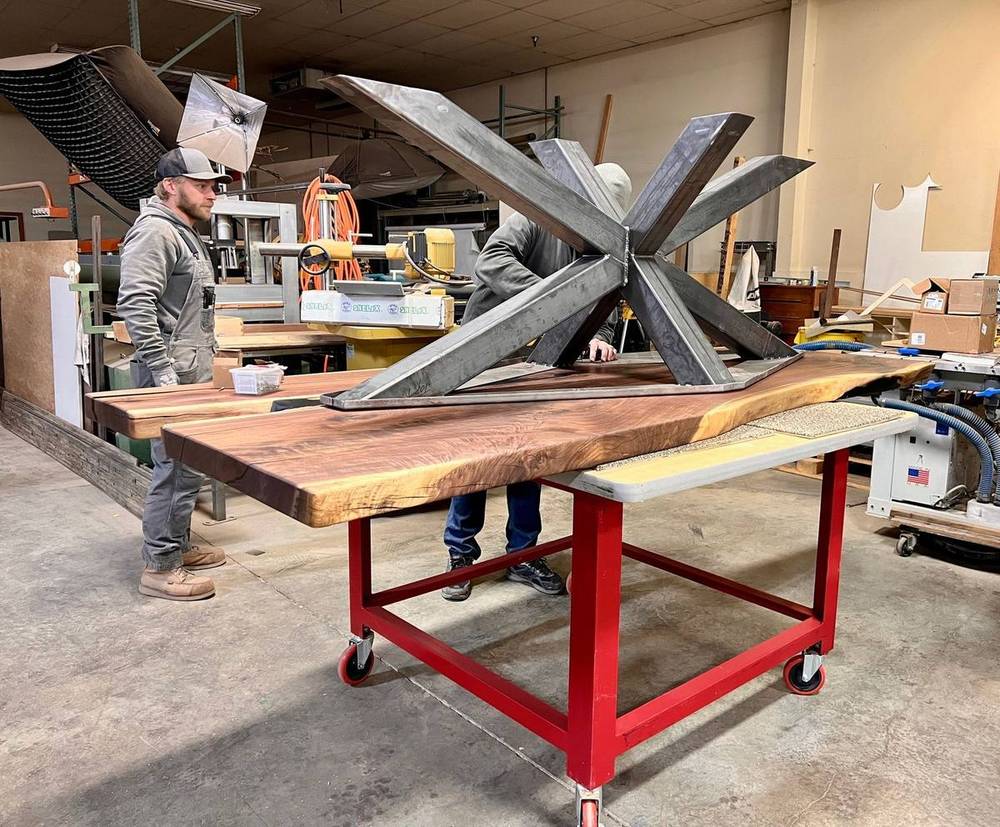
People call it a lot of things. Reclamation yard. Salvage yard. Architectural salvage. Restoration yard. Used building materials. Repurposed materials.
They mostly mean the same thing: a place that buys, stores and resells building material that came out of something else — a demolished building, a retired barn, a decommissioned power plant, a sports field at the end of its life.
This is a guide to how they work, because buying from one is genuinely different from buying at a lumber yard, and the differences catch people out.
What is a reclamation yard?
A reclamation yard takes material out of the waste stream before it reaches a landfill and puts it back into circulation. The material arrives through deconstruction (taking a building apart carefully rather than demolishing it), through donations, and through commercial diversion programs.
What separates a reclamation yard from a lumber yard is that the stock is finite and unrepeatable. A lumber yard can order more 2×4s. When a reclamation yard sells the last 1911 Douglas fir beam out of a particular building, that’s the end of it — there is no more.
That single fact drives everything else about how you buy.
What do they stock?
It depends entirely on what’s come through. At our yard on South Jason Street in Denver, that currently means:
| Material | Typical price |
|---|---|
| Reclaimed wood — live edge slabs | $8 – $35 / board ft |
| Boxcar flooring — rail car, 2.25in | $200 – $240 / board |
| Cargo flooring — semi-trailer, 1.25in | $14 / linear ft |
| Hand-hewn barn beams | $14 / board ft |
| Old-growth Douglas fir beams | $6 – $18 |
| Coal-fired steel sheets (COR-TEN baffles) | $3.50 / sq ft |
| Commercial carpet tile | $0.25 – $0.70 / sq ft |
| Used artificial turf | $0.35 – $0.90 / sq ft |
| Vinyl billboard tarps | $59 – $95 each |
A lumber yard has a catalogue. A reclamation yard has an inventory, and the inventory changes weekly.
Is reclaimed material actually cheaper?
Sometimes dramatically, sometimes not — and it’s worth being clear about which.
Much cheaper: commercial carpet tile and artificial turf. Carpet tile runs about a tenth of new commercial tile. Turf at $0.35 per square foot has no new equivalent at any comparable price.
Somewhat cheaper: softwood beams and dimensional stock. A reclaimed Douglas fir beam at $6 per board foot undercuts comparable new timber.
Not really cheaper — but not available new: wide black walnut slabs, old-growth fir with twenty growth rings to the inch, hand-hewn beams with the axe marks still on them. You’re not paying less. You’re buying something that cannot be manufactured, because the trees that made it took two hundred years to grow.
How to buy from a reclamation yard without wasting a trip
This is the part people get wrong.
Call first. Inventory turns over weekly and the good pieces move fast. A two-minute phone call beats a forty-minute drive to find the thing sold on Saturday.
Bring measurements, not just an idea. “Something for a mantel” is hard to help with. “72 inches wide, 8 inches deep, going over a stone surround” gets you walked straight to the right rack.
Bring the right vehicle. This is the single most common problem. Boards run to 20 feet. Turf rolls weigh 900 to 1,400 pounds and need a flatbed or an open trailer — a pickup cannot be loaded with turf, and people drive across town in one anyway.
Bring straps. Nobody remembers straps.
Expect to buy it that day. Most yards, ours included, don’t hold material. First come, first served is not rudeness — it’s the only fair way to sell one-of-a-kind stock.
Ask where it came from. A good yard can tell you the building, the barn, or the field. If nobody knows the provenance, that’s worth noticing.
What to check before you buy
- Moisture. Is it kiln dried, or has it just been sitting dry? Kiln-dried slabs are stable and ready to build with. Green material will move after you’ve built with it.
- Metal. Old timber can hide nails and screws that will destroy a planer blade. Ask whether it’s been checked.
- Real versus faked distressing. Genuine hand-hewing leaves irregular, overlapping scallop marks that never repeat. Machine-distressed lumber has a rhythm you can spot across a room once you know to look.
- Actual dimensions. Reclaimed stock is rarely a tidy nominal size. Measure the piece, not the label.
Reclamation yards in Denver
We’re at 800 S Jason St, Denver CO 80223 — last unit on the left, same street as Austin Hardwoods and about five blocks down from them. Open Tuesday to Friday 10–5 and Saturday 10–4, closed Sunday and Monday. Cash, card or Bitcoin, we load with a forklift, walk-ins welcome.
If we don’t have what you need, we’ll usually tell you who does. The reclamation world in Denver is small and most of us would rather material got used than sat.
Browse what’s on the floor right now, or call 720-236-0454.
Come see it in person.
800 S Jason St, Denver. Tue–Fri 10–5, Sat 10–4.